Impact of Day-Ahead Forecast Accuracy on BESS Revenues
Impact of Day-Ahead Forecast Accuracy on BESS Revenues
3 min read
Impact of Day-Ahead Forecast Accuracy on BESS Revenues
Battery revenues are often discussed as if the asset simply reacts to market volatility. In practice, a battery earns money by making decisions before prices are known. The forecast decides when to charge, when to discharge, and how much of the daily cycling budget to spend.
That makes forecast quality a commercial lever, not just a modelling metric.
Together with Electricity Maps, we looked at how day-ahead forecast accuracy translates into realized BESS revenues. The question was simple: if two forecasts see tomorrow's German day-ahead market differently, how much does that change what a battery would actually earn?
We ran a Jan–Mar 2026 backtest using German 15-minute day-ahead prices. For every delivery day, the battery dispatch was optimized using the forecast available before the day-ahead gate, then settled against the actual day-ahead price.
The analysis compares four signals:
Signal
What it represents
Previous-day baseline
A simple naive benchmark: tomorrow looks like yesterday
Re-Twin forecast
Re-Twin's day-ahead forecast
Electricity Maps forecast
Electricity Maps' day-ahead forecast
Perfect foresight
The theoretical upper bound using actual prices in advance
The BESS was modelled as a 10 MW standalone battery with 95% charge/discharge efficiency, 10–90% SoC limits. We tested 1h, 2h, and 4h durations, with 1, 1.5, and 2 cycles per day.
This is intentionally a day-ahead-only benchmark. The same approach can be extended to spot-market and fully merchant strategies, but those require matching intraday, balancing, and ancillary forecasts plus realized settlement prices.
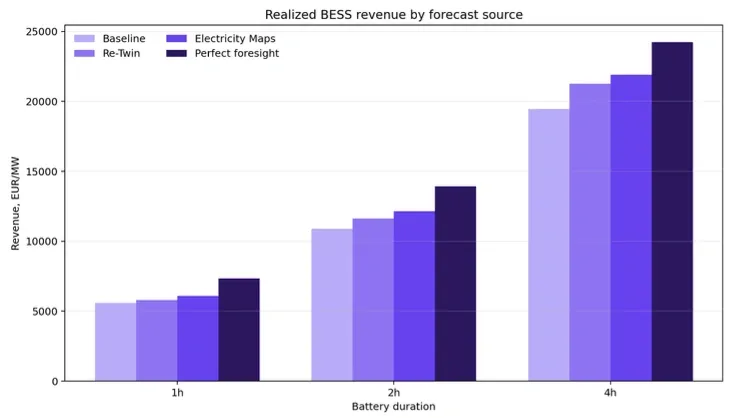
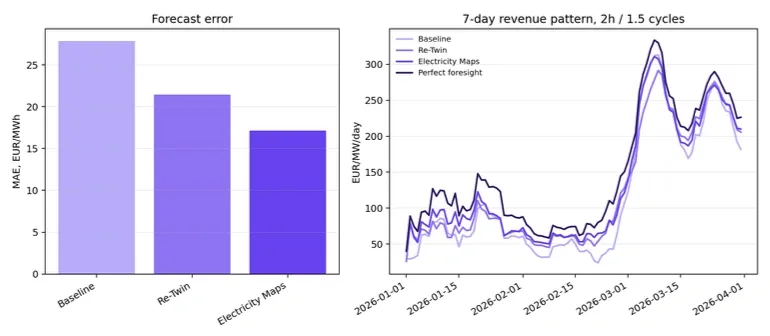
For a representative 2-hour battery with 1.5 cycles per day, Electricity Maps produced the strongest result in the backtest:
Forecast source
Realized revenue
Revenue captured vs perfect foresight
Gap to perfect foresight
Previous-day baseline
EUR 10,904/MW
78.4%
EUR 3,010/MW
Re-Twin
EUR 11,628/MW
83.6%
EUR 2,286/MW
Electricity Maps
EUR 12,163/MW
87.4%
EUR 1,751/MW
Perfect foresight
EUR 13,914/MW
100.0%
EUR 0/MW
The same pattern appears in the forecast error metrics. Electricity Maps had a mean absolute error of 17.2 EUR/MWh, compared with 21.4 EUR/MWh for Re-Twin and 27.9 EUR/MWh for the previous-day baseline.
The important point is not just that the forecast error was lower. It is that lower error changed the dispatch. The battery made better use of its limited cycle budget, avoided more low-value spreads, and captured more of the revenue that would have been available with perfect information.
A BESS optimizer is constrained. It cannot simply trade every spread in the day-ahead curve. It has finite power, finite energy capacity, efficiency losses, SoC limits, and cycle limits. A forecast error therefore has two effects:
It can make the battery charge or discharge at the wrong time.
It can spend scarce cycle budget on a spread that looked attractive in the forecast but was less valuable in reality.
That second effect is where forecast accuracy becomes especially important. A poor forecast does not just miss a price; it can reserve the battery for the wrong opportunity.
In this backtest, the 2h / 1.5-cycle battery using Electricity Maps captured 87.4% of perfect-foresight day-ahead revenue. Re-Twin captured 83.6%. The difference is a practical measure of how much more value the better forecast unlocked from the same physical asset.
Forecast accuracy is not an abstract performance statistic for BESS operators. It directly affects market decisions, cycle allocation, and realized revenue.
In this Jan–Mar 2026 German day-ahead backtest, Electricity Maps delivered both lower forecast error and higher realized BESS revenue than the other non-perfect signals. For the representative 2-hour battery case, it reduced the gap to perfect foresight to EUR 1,751/MW, compared with EUR 2,286/MW for Re-Twin and EUR 3,010/MW for the previous-day baseline.
For developers, investors, and optimizers, this is the core lesson: better forecasts help batteries capture more of the value that volatility creates.
About the Author
Prasad Hadbe
Prasad Hadbe is a Data Engineer with expertise in AI, machine learning, and data science. His work focuses on building intelligent forecasting and analytics systems that transform complex energy-market data into practical business insights. With a strong foundation in data-driven problem solving, he is passionate about applying AI and ML to real-world energy challenges and creating solutions that support smarter, faster, and more informed decision-making.
Ready to Transform Your Energy Strategy?
Unlock the full potential of your energy assets with Re-Twin Energy's cutting-edge Analytics & AI platform